


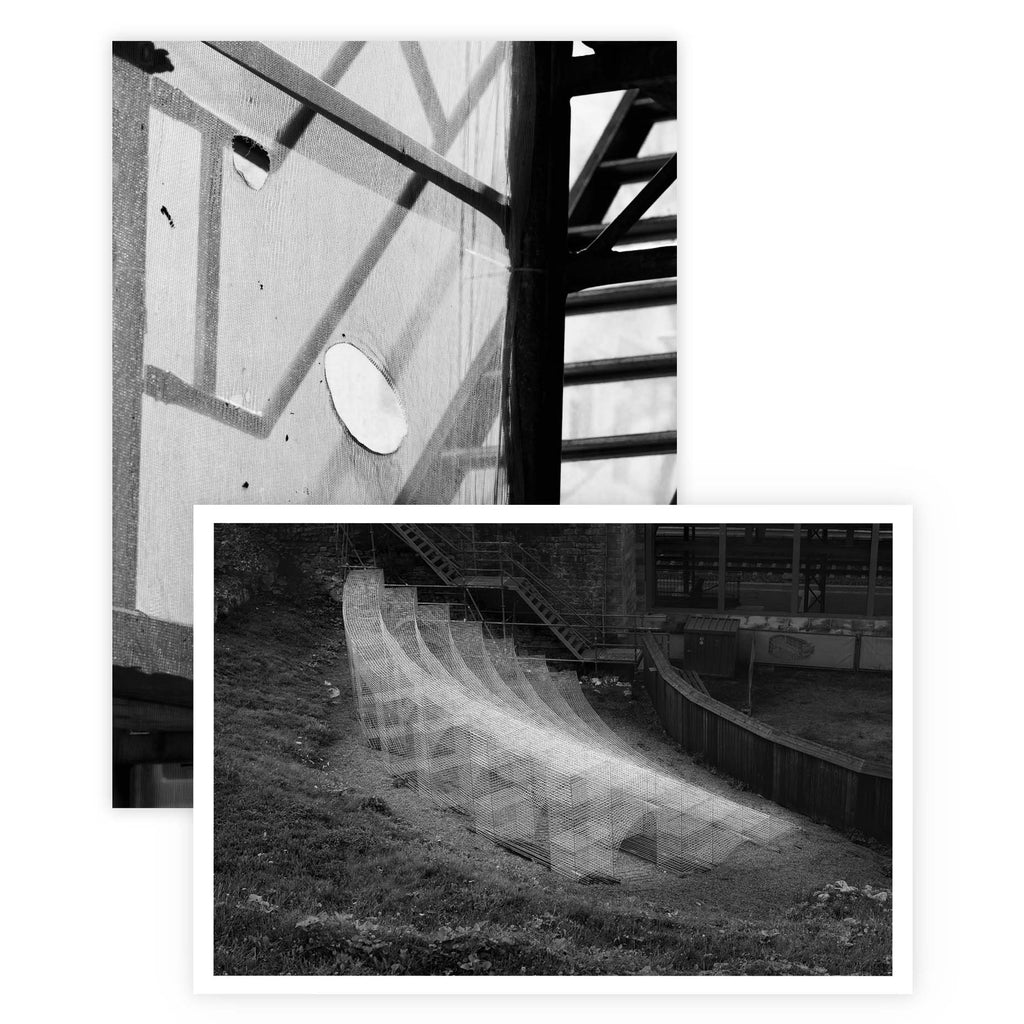


Print size: 27 x 18
Softcover with thread stitching
76 pages
44 B/W photographs
Tritone printing
21.6 × 29.3 cm
Edition of 500 copies
(30 special edition copies include a signed print on baryta paper)
Editing by Jonas Feige and Misha Kominek
Design by Jonas Feige, Krispin Heé & Tim Wetter
Kominek Books, 2021
History is an errant and pliable concept that haunts dreams and fuels the imaginations of the living. It refuses to be fixed, and through its continual motivation for disobedience, it shapes society’s relationship with recorded events, moments, and changes that have led to our understanding of the present. History challenges our perception of itself as something impartial or bearable. By abandoning certainty, history presents ambiguity rather than a solid foundation from which to draw rationality. We seek historical narratives as a way to illuminate our beliefs, however imperfectly constructed.
Significant themes are constantly revisited throughout history, reforming institutions and cultural movements alike. Stories of the past can be borrowed, reshaped, and modified to create new narratives. The citizens of the present often use these themes to reinterpret historical episodes as credentials and reference points for contemporary agendas. As theorist and historian Frederic Jameson noted, treating history and its components as fixed is a failure to recognize its mutable nature. His statement, “Always Historicize!”, remains a crucial response to the problems surrounding history, the past, and their manipulation in the present.
History, at its best, is a condition of reverberation and echo. There is an inherent relationship between history and the past, yet it can never be fully grasped by those who did not experience it firsthand. These echoes can become convenient when they reinforce political confirmation biases. In such cases, they can undermine rational thought in favor of misinterpretation or mythologizing, presenting history as immutable and absolute.
Jonas Feige’s This Soil We Have Created for Ourselves suggests that history is both an echo and a shadow. The artist photographs his native Germany, his Heimat, with a deeply poetic sensibility. Beneath the beauty of Feige’s images lies the suggestion that history remains incomplete, and that the echoes of the past are not fading but growing louder.
Through a lyrical approach to German history and its contemporary interpretations, Feige presents images of profound significance. The 1936 Berlin Olympic Stadium, with its cracked bell bearing a swastika, becomes an example where historical reverberation is both literal and metaphorical. His use of shadows across the facades of German homes suggests an ideological tension mirrored by the concept of the Volk residing within those walls.
The weight of history and nationhood casts a long shadow over the present that Feige photographs, inviting reflection on the potential influence of the past on Germany’s future. The book serves as a powerful reminder that history and its complex discourses are never truly closed, and that its themes can always be reinterpreted—sometimes in troubling ways.
— Brad Feuerhelm