


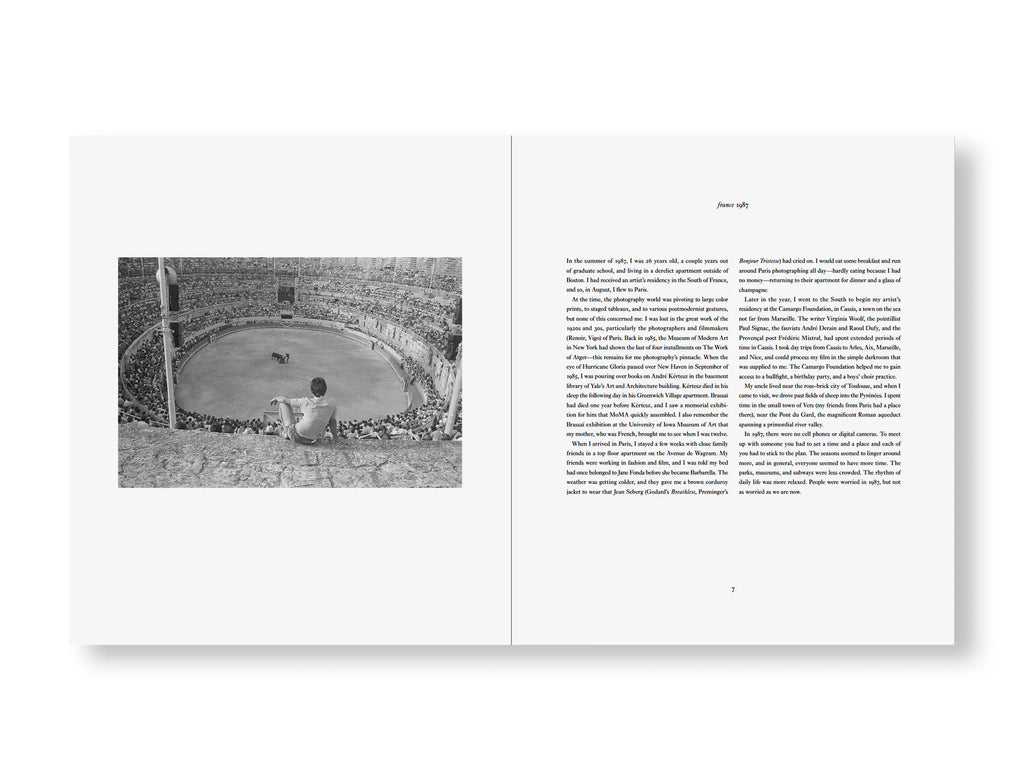
Hardcover, cloth
10.5 × 12 inches
80 pages
63 plates
Nazraeli Press
“In the summer of 1987, I was 26 years old, a couple years out of graduate school, and living in a derelict apartment outside of Boston. I had received an artist’s residency in the South of France, and so, in August, I flew to Paris.
I stayed a few weeks with close family friends in a top-floor apartment on Avenue de Wagram. My friends were working in fashion and film, and I was told my bed had once belonged to Jane Fonda before she became Barbarella. The weather was getting colder, and they gave me a brown corduroy jacket to wear that Jean Seberg (Godard’s Breathless, Preminger’s Bonjour Tristesse) had cried on.
I would eat some breakfast and run around Paris photographing all day—hardly eating because I had no money—returning to their apartment for dinner and a glass of champagne.”
Later that year, I went to the South of France to begin my artist’s residency at the Camargo Foundation in Cassis, a seaside town near Marseille. The writer Virginia Woolf, the pointillist Paul Signac, the Fauvist artists André Derain and Raoul Dufy, and the Provençal poet Frédéric Mistral had all spent extended periods of time in Cassis.
I took day trips from Cassis to Arles, Aix, Marseille, and Nice, and processed my film in the simple darkroom that was provided for me.
In 1987, there were no cell phones or digital cameras. To meet someone, you had to set a time and a place, and each person had to stick to the plan. The seasons seemed to linger longer, and in general, everyone appeared to have more time. Parks, museums, and subways were less crowded. The rhythm of daily life was more relaxed. People were worried in 1987, but not as worried as we are now.”
— From the introduction by Mark Steinmetz
This collection of previously unpublished photographs by Mark Steinmetz, made around 35 years ago during an extended stay in the South of France, offers a unique insight into his earliest years as a working artist.
The book brings together more than 60 photographs, beautifully printed in duotone on Japanese Kasadaka art paper and bound in burgundy linen.
Limited to 1,000 casebound copies, France 1987 is a remarkable portrait of a formative period in Steinmetz’s career.